
Wei-Cheng Chiu
邱偉誠
Taipei, Taiwan · UTC+8
making every FLOP count
Which patch cleared the FlashInfer fault
On this page
Which patch cleared the FlashInfer fault on my card
2026-11-16 · vLLM / FlashInfer / debugging
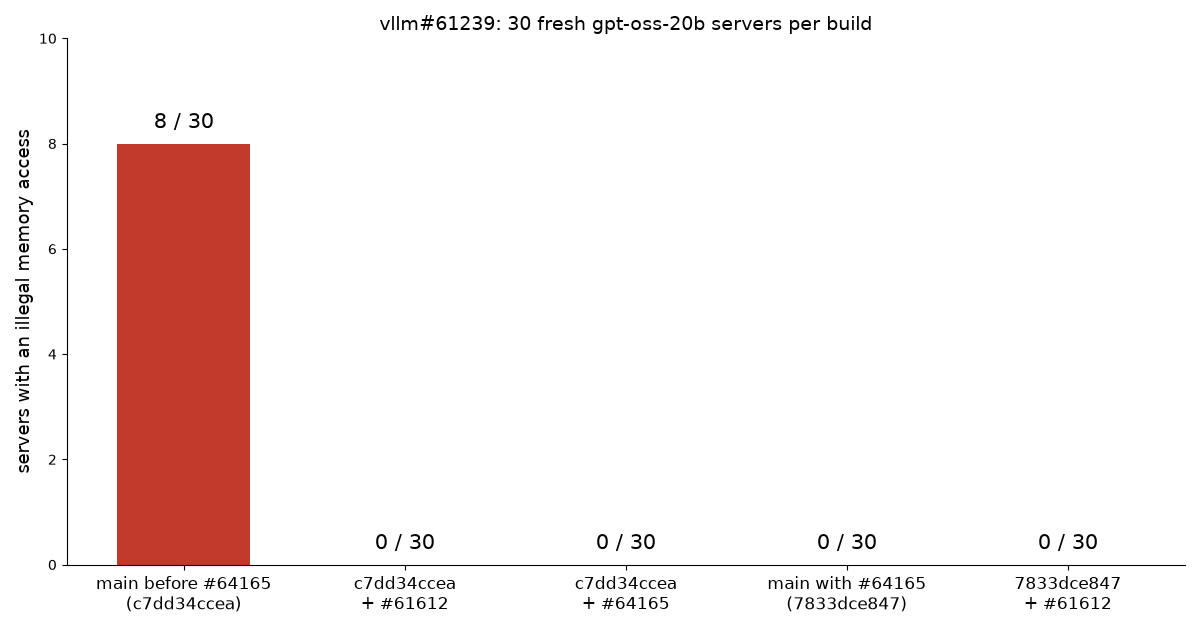
vllm#61239 reports CUDA illegal memory accesses under async scheduling with FlashInfer, on models without speculative decoding.1 Two patches were candidates. #61612 drops the seq_lens_cpu_upper_bound shortcut under async scheduling. #64165 is vadiklyutiy's fix for a pipeline parallel crash (#63505): build() now waits until the GPU has copied the previous plan out of the page-locked buffer before it calls plan() again. I wanted to know which one clears the fault on my card, so I ran 30 fresh servers on each of five builds. Main with #64165 never faulted; main before it faulted in 8 of 30.
Setup
One Blackwell workstation GPU under WSL2, openai/gpt-oss-20b (sliding and full attention, no GDN or linear-attention layers), FlashInfer picked automatically, async scheduling on, no spec decode, no prefix caching, --max-num-batched-tokens 8192. Every server starts fresh and runs GSM8K: 1,319 chat requests at 64 concurrent. Five builds, 30 servers each, run interleaved and reshuffled every round, so a bad hour on the box lands on every build alike.
| vLLM | servers | illegal memory access | GSM8K wall time (median, no fault) |
|---|---|---|---|
main c7dd34ccea, before #64165 |
30 | 8 | 69 s |
c7dd34ccea + #61612's flashinfer.py change |
30 | 0 | 70 s |
c7dd34ccea + #64165's flashinfer.py change |
30 | 0 | 69 s |
main 7833dce847, with #64165 |
30 | 0 | 69 s |
7833dce847 + #61612's change |
30 | 0 | 70 s |
All 8 faults raised at copy_event.synchronize() in async_utils.py, 4 to 49 s into the load. 8 of 30 against 0 of 30 gives a one-sided Fisher p of 0.0023. GSM8K accuracy (flexible match) stayed between 0.924 and 0.939 on every build.
What I take from it
For this case I read #64165 as the fix. Main with it never faulted, and neither did the older main with only #64165's flashinfer.py change. I can't say #61612 does nothing, though. Zero faults in 30 servers only puts each build's fault rate under about 10% at 95% confidence, so the run only shows that #61612 isn't needed to clear the fault I saw.
The faults came in a cluster. All 8 landed in unpatched servers 5 to 21, and the last 9 were clean. I still don't know why. A later unpatched run with core dumps on faulted again on its 4th server, so it hadn't gone away.
64165's description says the new wait never blocked on one GPU (0 of 2,000 builds). I put a counter around its _plan_copied.synchronize() on main. Over 3 servers, each with at least 2,000 plan builds, it blocked twice, about 20 ms each, in the middle of the load. So the window does open in normal serving, just rarely.
A CUDA core dump of one unpatched fault puts it in flashinfer::BatchPrefillWithPagedKVCacheKernel. That kernel reads its offsets from the plan info plan() copies out of the page-locked buffer, so the dump fits the race. A dump can't prove it, though.
What this doesn't cover
The issue's own shape (one 4,097-token prompt at a time, --max-num-batched-tokens 2048, prefix caching on, bf16 or fp8 KV) never faulted in 6 servers here, even unpatched. So this says nothing about that path, on sm80, or with a hybrid model.
This is also WSL2, where vLLM leaves pinned memory off for its own buffers unless VLLM_WSL2_ENABLE_PIN_MEMORY=1 is set (I didn't set it). FlashInfer still allocates its plan buffer with pin_memory=True, so the copy in question is the same, but the timing around it may differ from bare Linux.
I posted the same numbers on the issue on 2026-11-14 and asked whether anyone who hit it on the original setup can retry on current main.2 The scripts, the patches as applied, per-server results, a fault traceback and the core dump reading are in the gist.3
-
vllm-project/vllm#61239, "FlashInfer metadata builder races under async scheduling for non-speculative models since #57214". ↩
-
My comment on vllm#61239, 2026-11-14. ↩
-
Scripts, patches, per-server results and the core dump reading. ↩